
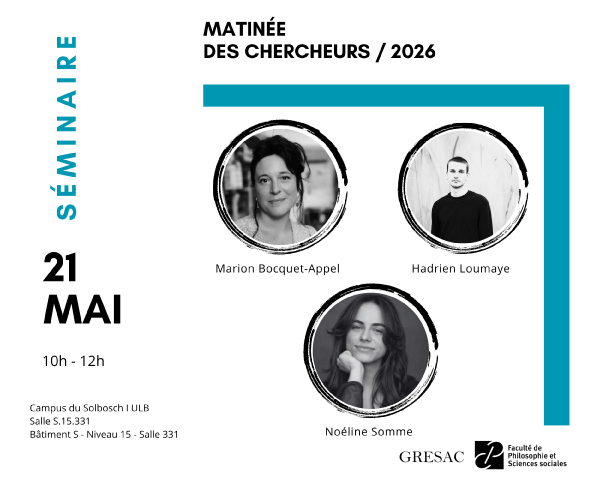
La matinée des chercheurs
10h00 - 12h00
Nous vous proposons de découvrir les travaux menés au GRESAC : des membres de l’équipe présenteront l’avancement de leurs recherches. Nous aurons le plaisir d’assister aux présentations d'Hadrien Loumaye (ULB-GRESAC), de Marion Bocquet-Appel (ULB-GRESAC) et de Noéline Somme (SBSEM, CEBRIG).
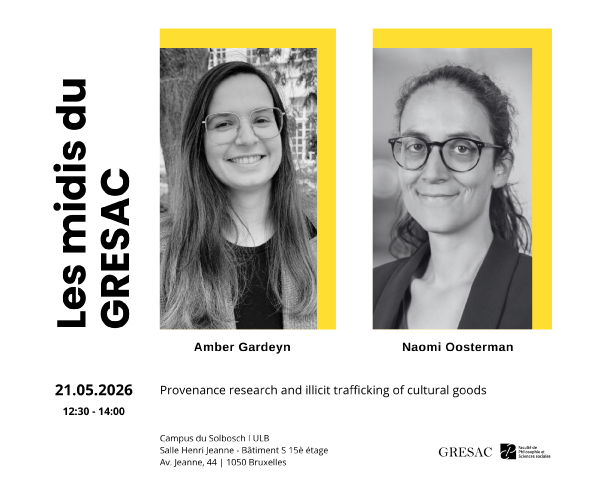
Les Midis du GRESAC
12h30 - 14h00
Lagging behind the neighbours: Belgium and Nazi-spoliated art, Amber Gardeyn (UGhent)
This presentation critically examines the frequently repeated assertion in popular media and public discourse that Belgium has lagged behind comparable European countries in addressing the legacy of art spoliated during the Nazi occupation. Rather than accepting this claim at face value, the study asks whether it withstands scrutiny when assessed through the lens of comparative and contextual legal history. To that end, Belgium is analysed alongside France and the Netherlands—two countries that, like Belgium, experienced occupation, large‑scale wartime spoliation, and complex post‑war restitution challenges. By situating national initiatives within their specific legal, political, and historical contexts, the presentation seeks to determine whether Belgium’s approach should indeed be considered as lagging, and if so what are the reasons behind that.
The effects of art thefts of auction sales: Some careful perspectives, Naomi Oosterman (Erasmus University Rotterdam)
This presentation discusses how reported art thefts affect the price of artworks in auction sales. By using criminal data from Interpol’s International Stolen Works of Art Database (SWoA) from 2002 to 2016, and auction data concerning all lots put at auction by Christie’s, Sotheby’s, and Phillips in New York and London between 2012 and 2016, we built dataset on top-tier international auction sales of modern and contemporary artists whose artwork have previously been stolen. The empirical analysis is based on an economic framework of the art auction and on hedonic regression models to test the effect of theft on auction prices. The results hint at a negative effect of theft on the prices of the artworks at market level, which gets stronger as the number of reported stolen artworks from the same artist increases. Overall, this presentation aims to provide a nuanced understanding of the complex incentives and disincentives surrounding the reporting of stolen artworks, emphasising the need to balance private interests with broader goals of art theft prevention and recovery. It invites further exploration of potential solutions and their practicality in addressing these conflicts of interest in the art world.
Bio
Amber Gardeyn is PhD candidate at the Institute for Legal History at the Law and Criminology Faculty of Ghent University. She is currently working on a Phd that will be titled: Taking the long way home: the Belgian practice regarding Nazi spoliated cultural objects in a comparative legal-historical perspective (1933-2026), under the academic guidance of prof. Georges Martyn (Ghent University) and prof. Bert Demarsin (KU Leuven). She is also a founding member of GRACE (Ghent Research institute on Art and Cultural Heritage Crime and law Enforcement).

Bio
Naomi Oosterman is Assistant Professor of Cultural Heritage at the Department of Arts and Culture Studies of Erasmus University Rotterdam. Her research interests are the illicit trade of arts and antiquities (with a particular focus on Latin America), the policing of art and heritage crimes, and contested and colonial heritage. She has published widely on these topics. She is the editor (with Dr. Donna Yates) of the volumes Crime and art: Sociological and criminological perspectives of crimes in the art world and Art Crime in Context, which were the first volumes dedicated to the sociological and criminological study of art and heritage crimes. In 2024, she published the volume (with Camila Malig Jedlicki and Dr. Rodrigo Christofoletti) which explores, among other things, the relationship between the illicit trafficking of cultural objects and decolonial thought. Naomi is the PI of the LDE Global Initiative project titled Policing the Illicit Trade in Cultural Objects: A pilot in Argentina and Uruguay, which examines decision-making processes and attitudes of public policing actors in the policing of art and heritage crimes. In 2025, she was awarded a €3.000.000 MSCA Doctoral Network grant titled HERITOUR that investigates how heritage and tourism are increasingly framed as objects of risk requiring surveillance, control, and protection.
ℹ️ Merci de vous inscrire, à l’ensemble des présentations ou à une partie de celles-ci au choix, via ce lien avant le lundi 18 mai
Inscription
10:00 - 14:00
Campus du Solbosch - ULB | Salle Henri Janne
Bâtiment S, 15è étage, S15.331
44 avenue Jeanne, 1050 Bruxelles