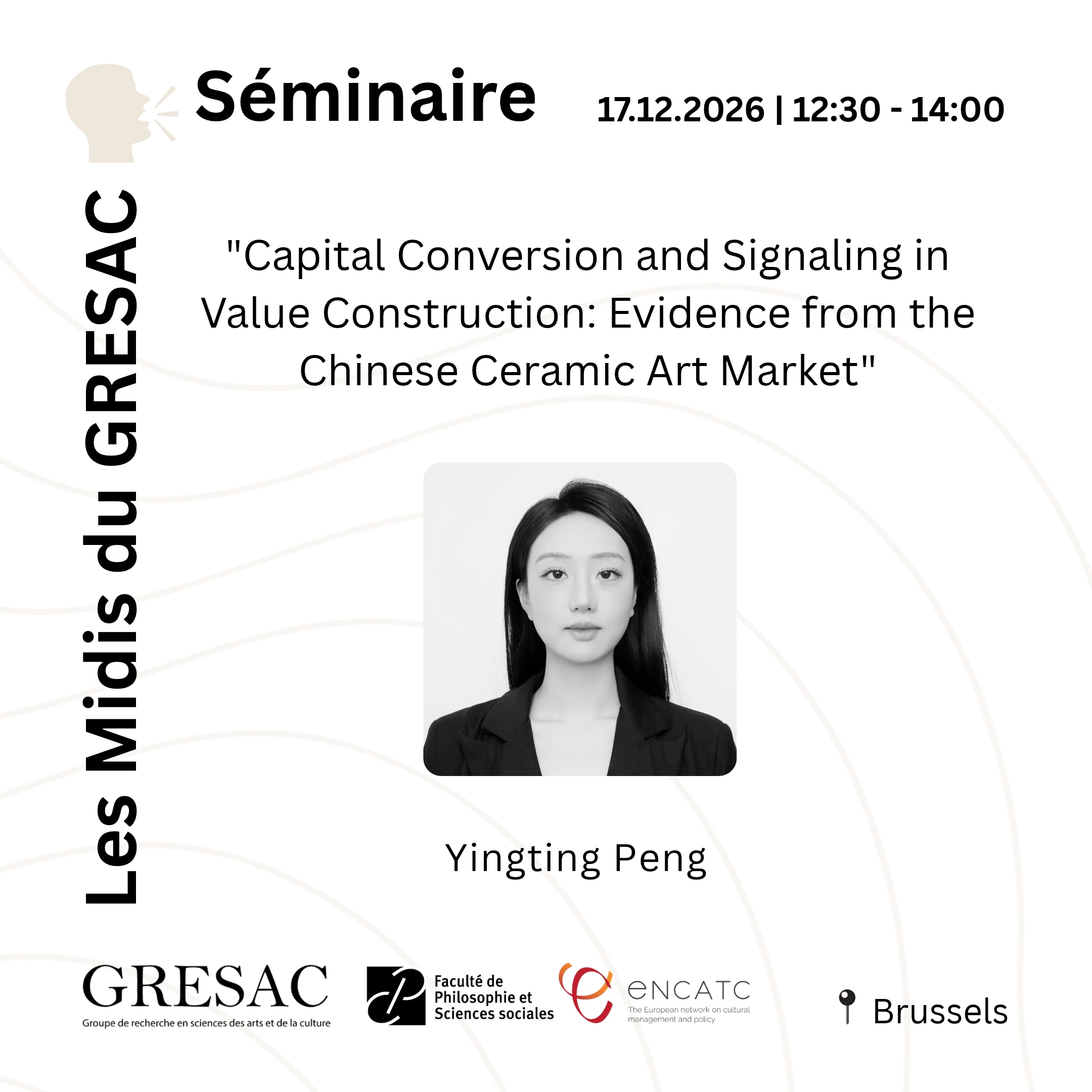
Drawing on Bourdieu’s field theory and his notion of capital conversion and Spence’s signaling theory, this study examines how artists’ non-economic resources are transformed into economic value within art markets. Specifically, it investigates the effects of artist’s social, cultural and symbolic capital as signals of quality on influencing the prices of their artworks. Contemporary Chinese ceramic art at auction, with its dual reliance on artistic creativity and technical craftsmanship, provides a compelling case through which to test these mechanisms. We focus on four forms of artist-related capital (family inheritance, apprenticeship experience, formal art education, and the honorary title of ‘China Master of Arts and Crafts’) and assess how they function as market signals. In this study, we employ a multilevel mediation model on 3,060 ceramic artworks by 69 contemporary Chinese ceramic artists sold at auction in China between 2008 and 2023, and analyze how these resources reduce information asymmetry, authenticate artistic quality, and generate symbolic recognition. The results indicate that social and cultural capitals of artists - family inheritance, apprenticeship, and art education - do not directly bring premiums on artwork prices. However, these capitals can significantly help artists acquire the master title, which itself exerts substantial direct price-enhancing effects on artworks. As a form of symbolic capital of artists, the master title serves as a powerful signal that directly generates premium prices and plays a crucial mediating role in how other variables affect artwork prices. The main finding reveals distinct effects across capital types, with the master title suppressing and mediating the influence of inherited, trained, and educational capital on prices. By empirically verifying these pathways, our study advances the sociological understanding of reputation formation and price construction in contemporary art markets.